The User-Agent Was Never Identity: Verifying Web Bot Auth Signatures in Practice

Every bot-detection conversation starts with the same question: who is this client? For thirty years the web’s answer has been a header the client writes about itself. RFC 1945 defined the User-Agent field in 1996 “for statistical purposes, the tracing of protocol violations, and automated recognition of user agents for the sake of tailoring responses to avoid particular user agent limitations”. Nothing in that sentence is about identity. We built allowlists on it anyway.
The two checks we bolted on later, published IP ranges and reverse DNS, are an audit of the name tag, not a replacement. Google’s own instructions for verifying Googlebot are a reverse DNS lookup followed by a forward DNS lookup, or matching the address against a JSON file of IP ranges. That works because Google can afford to publish and maintain IP space. It says nothing about everyone else’s crawler, and it ties an identity to infrastructure instead of to a key.
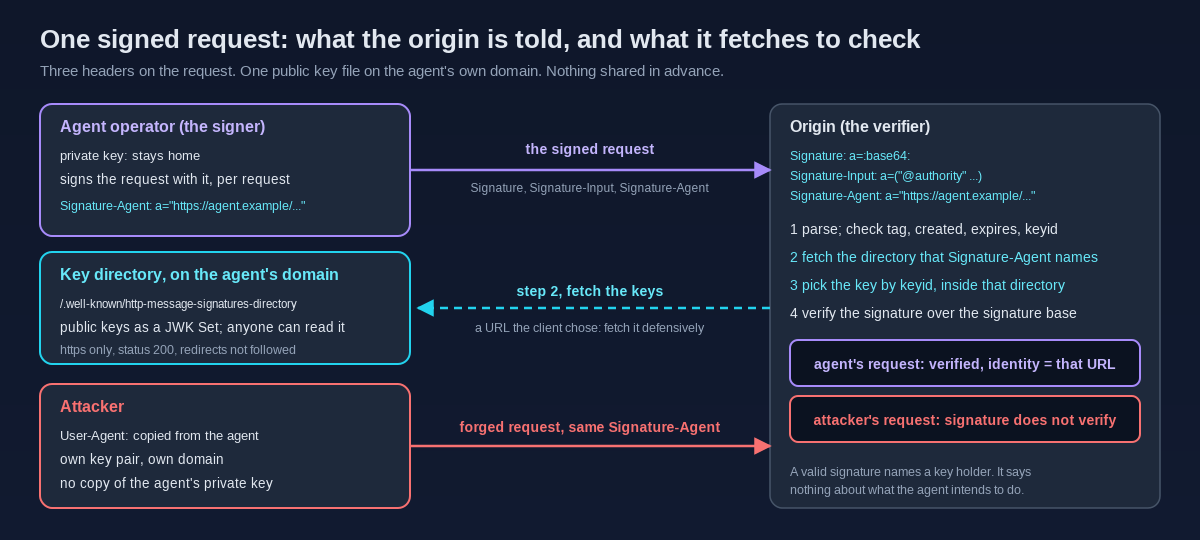
Web Bot Auth changes the primitive. The agent signs a request with a private key and points at a public key file on its own domain. The site fetches that file and checks the signature. No prior relationship, no shared secret, no IP list. Google signs a subset of the requests made by its Google-Agent user agent and authenticates them as https://agent.bot.goog. OpenAI, Meta, Apify and Browserbase publish key directories at the same well-known path. Cloudflare calls it “our preferred method” for agent identity.
The specification is an Internet-Draft, version -01 published on 29 October 2026, and it is honest in a way specifications rarely are: it states exactly what a valid signature does not prove. In our view it is the right shape and the right scope. It is also moving under its first deployers. Three generations of the header are documented or reported as live, one of the six directories we checked fails the draft’s own check for a signed directory, and the first deployer does not ship the key identifiers the draft requires. So the advice at the end is deliberately boring: log it, do not trust it yet, keep the IP checks.
This article covers what the protocol is, what a valid signature actually buys you, a verifier we wrote to find out, and what six live key directories on the Internet looked like on 25 November 2026.
Thirty Years of Asking Bots to Announce Themselves, Then Auditing the Announcement
The User-Agent header was always a courtesy. RFC 9110, the current HTTP semantics standard, still only says that “a user agent SHOULD send a User-Agent header field in each request”. Then robots.txt made the courtesy expensive. RFC 9309, which standardized the Robots Exclusion Protocol in 2022, describes a scheme “originally defined by Martijn Koster in 1994” in which crawlers announce themselves by a product token that is supposed to be a substring of their User-Agent string, and sites address rules to that token. The moment a header decides what you are allowed to fetch, it is worth lying about.
So the industry learned to check the claim against something else. Google documents two methods: run host on the crawler’s address, confirm the name ends in googlebot.com, google.com or googleusercontent.com, then run host on that name and confirm you get the same address back; or match the address against published IP ranges. Cloudflare’s Verified Bots documentation lists those same checks next to the new one: honest self-identification “through a cryptographic Web Bot Auth signature, a published IP list with a stable user-agent, or reverse DNS”.
The working group’s own draft is blunt about why this is unsatisfying. A User-Agent “can be spoofed meaning anyone may attempt to act as that agent”. IP blocks “alone can present a confusing story”, because cloud platforms own the addresses and the agent merely rents them. And a bearer token shared with every site does not scale and rotates badly.
Signing an HTTP request is not new technology. RFC 9421, HTTP Message Signatures, was published in February 2024. The new part is the key directory: Cloudflare proposed in May 2025 that friendly bots should sign requests and publish their public keys in a directory on their own domain, under the title “Forget IPs: using cryptography to verify bot and agent traffic”. An IETF working group was chartered on 23 October 2025, and Google started documenting the Google-Agent user agent in March 2026 and Web Bot Auth verification in May.
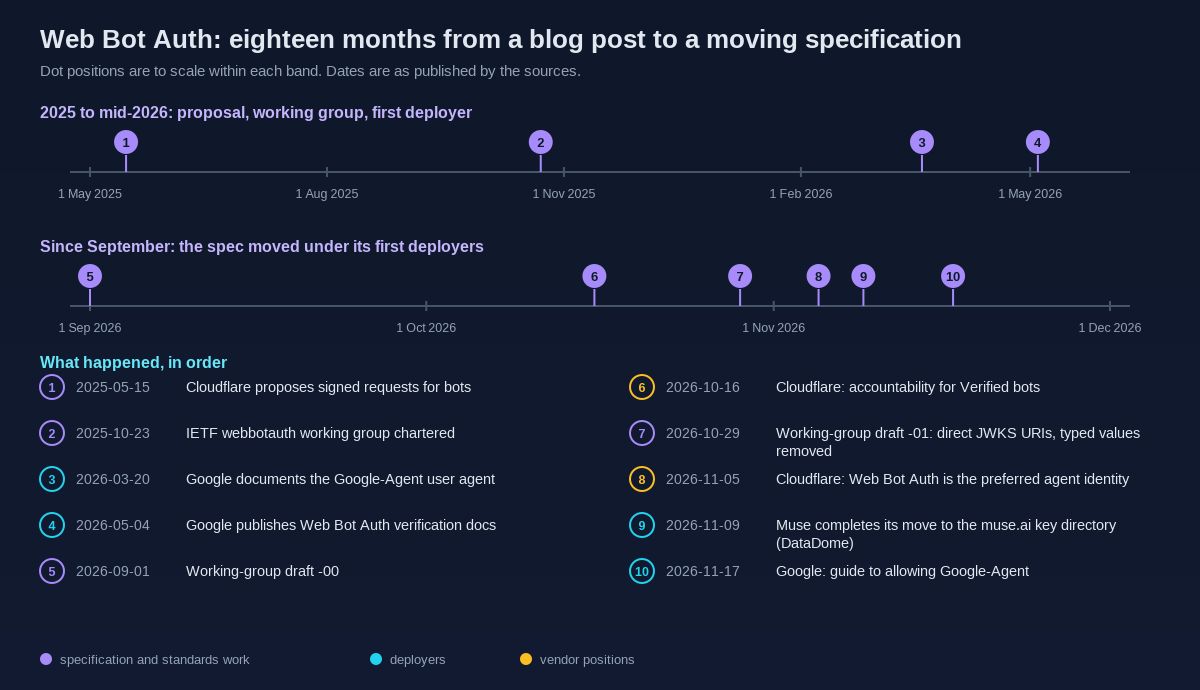
Read the bottom band of that timeline again. Working-group draft -00 arrived on 1 September 2026. -01 followed on 29 October and removed a discovery type that Google’s documentation still describes. Muse changed its signing identity between 7 and 9 November. A specification that rewrote its discovery section eight weeks after its first working-group draft is a specification you deploy next to a fallback, not instead of one.
We have written about the detection side of this before: which signal blocked your scraper, what Patchright hides from a site, and Cloudflare’s economics of blocking. Those articles asked whether a client is automated, and which tell gave it away. Web Bot Auth answers the question that comes after: fine, it is a bot, so whose bot is it?
One Sentence on What a Valid Signature Proves, Then a Page on What It Does Not
A signed request carries three headers. This is real output from the PoC, with a throwaway key:
GET /data?page=2 HTTP/1.1
Host: origin.example.com
Signature: a=:kJRzgledcX76xsjxWrO+H3wqU0fJmQpzoDalPRkNMp1RY28iyXTpJS6LrYCf/Gd/jcUSMrXPqIcwWfYxlHGnAw==:
Signature-Input: a=("@authority" "signature-agent";key="a" "@method" "@path");created=1795190400;expires=1795190700;keyid="Ni3gdSK3aSf0KqymmMSz_BAPdZUV7pHiTUdXpRkhBE4";alg="ed25519";tag="web-bot-auth"
Signature-Agent: a="https://agent.example/.well-known/http-message-signatures-directory"
Signature-Agent says where the public key lives. Signature-Input lists what was signed and the parameters of the signature. Signature is an Ed25519 signature over a canonical text that both sides build independently from their own view of the request:
"@authority": origin.example
"signature-agent";key="a": "https://agent.example/.well-known/http-message-signatures-directory"
"@method": GET
"@path": /data
"@signature-params": ("@authority" "signature-agent";key="a" "@method" "@path");created=1795190400;expires=1795190700;keyid="Ni3gdSK3aSf0KqymmMSz_BAPdZUV7pHiTUdXpRkhBE4";alg="ed25519";tag="web-bot-auth"
The rules the draft puts on that header set are short:
- Coverage. The agent must sign
@authorityor@target-uri, plus theSignature-Agentmember keyed to its own signature label. Signing@methodand@pathis a SHOULD, and a signer that omits them is still conformant. The body is covered only if the agent also sends and signs aContent-Digest. - Parameters.
createdandexpiresare mandatory, withexpiresrecommended to be no more than 24 hours out.keyidmust be the base64url SHA-256 thumbprint of the key.tagmust beweb-bot-auth. - Discovery. The value of
Signature-Agentmust be anhttpsURL. The verifier fetches it and reads a JWK Set. Anything other than a 200 is a discovery failure, and redirects are not followed.
Now the one sentence, from Section 4.1 of the draft:
A valid signature over a resolved URL proves that a holder of a key that URL publishes signed the covered message.
Then the draft finishes the thought, and this is the part we would print out and tape to a monitor:
It says nothing about who operates the Agent, whether the Agent is benign, or whether the request is authorized. Those are origin policy.
Everything that follows is a footnote to that paragraph.
The Minimum Conformant Signature Is a Bearer Credential for Your Whole Host
The draft does not hide this either: “A signature covering @authority alone verifies against any method, path, or body sent to that authority until it expires, so anyone who observes one request can reuse it against the same origin until then.” A log file, a proxy, a TLS-terminating CDN: anything that sees the headers once can replay them for the rest of the lifetime, against any path on that host. How much that matters is decided by the signer’s coverage and by the verifier’s policy, not by the cryptography. And coverage has edges worth knowing: @path is the path without the query string, so a request signed for /search?q=cheap verifies for /search?q=expensive unless the signer covers @target-uri or individual @query-params.
The Identity Is the URL, and a URL Is Something You Can Walk Away From
“The identifier is the URL the verifier fetched.” That choice buys cheap key rotation: an agent publishes a new key next to the old one under the same URL, and every verifier that recognised it before still recognises it. It also means a new URL is a new identity, which is exactly what happened to Muse. And it means the identity is only as durable as the operator’s patience with a domain, as the draft says plainly: “Nothing stops an Agent from abandoning a URL and standing up another one, and the protocol does not try to prevent this. It targets honest clients that want to be recognised across requests.” If you were hoping for a reputation system, this is not one. Section 4.6 puts it out of scope: the protocol “does not define how trust is accrued, held, or exchanged”.
The Directory Is the Soft Spot: Cached, Unregistered, and Unrevocable
The keys live in a JWK Set at /.well-known/http-message-signatures-directory, served over HTTPS with the media type application/http-message-signatures-directory+json. Neither the URI suffix nor the media type was in the IANA registries when we looked on 25 November 2026, which is normal for a draft and worth knowing before you hard-code a check for either. Verifiers are told to cache the directory by its Cache-Control and to bound every fetch, because the URL comes from an untrusted client: “Verifiers SHOULD prevent directory fetches to private, loopback, and link-local address ranges.” A verifier without that guard is an SSRF primitive with extra steps.
Appendix B recommends that a directory sign its own response, covering the @authority of the fetching request and a Content-Digest of the body, so that the key set can neither be re-served under another authority nor swapped under a captured signature. It is a recommendation, and we will see in a moment who follows it.
There is no revocation. “This document defines no revocation. Removing a compromised key from the directory is the only remedy, and it takes effect at each verifier on its next refresh.” The cache lifetime is therefore your revocation latency, and a short signature lifetime is the only lever that acts faster.
Three Outcomes, Not Two, and One Lookup Rule That Is a MUST
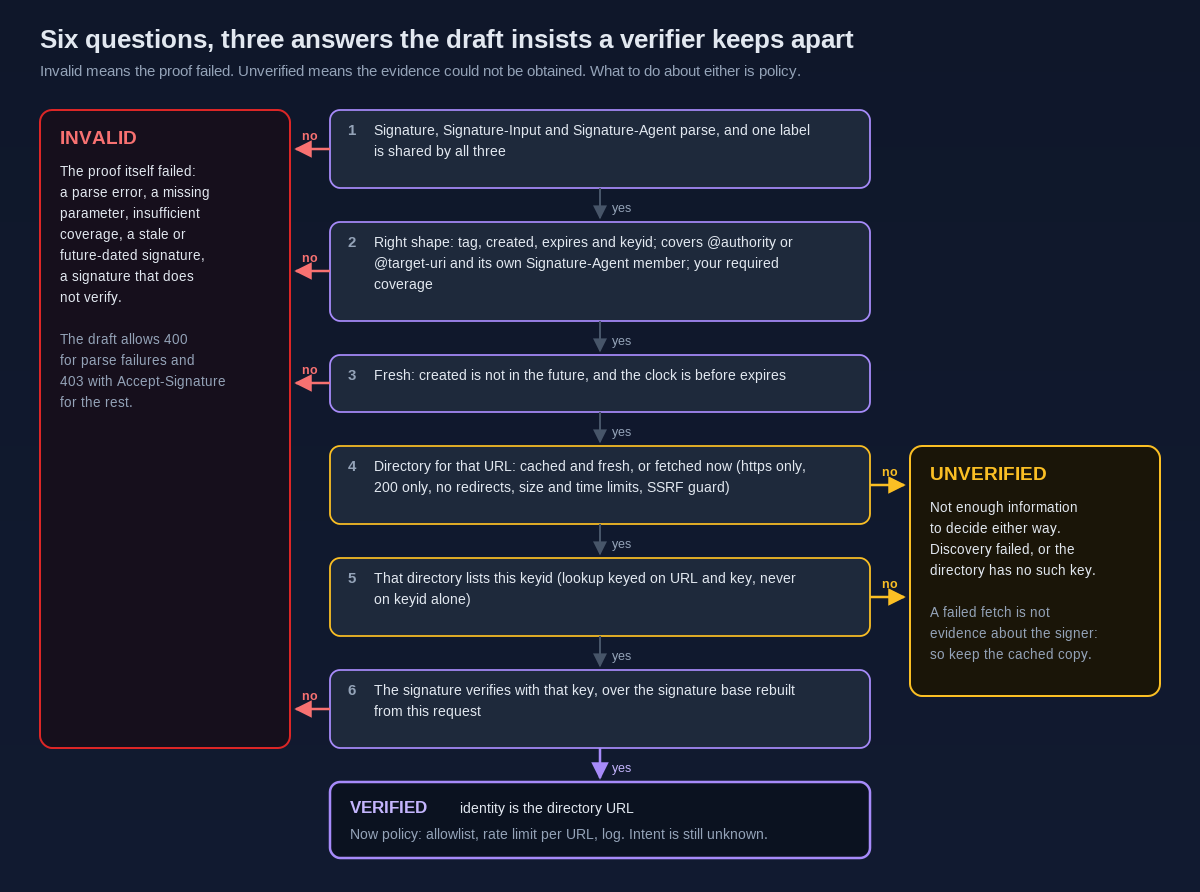
Appendix C.1 tells verifiers to keep three outcomes apart. Verified: the signature and key material validate. Invalid: the signature, covered components, key or freshness checks fail. Unverified: the verifier cannot obtain enough information to decide, because discovery failed or the directory does not provide the key. During deployment, the draft says, “treating unverified as one bot-management signal is safer than treating it as either verified or invalid”.
Two rules inside that flow are the ones we would expect a rushed implementation to get wrong:
- Key lookup is keyed on the (URL, key) pair, never on the key alone. The draft makes this a MUST and explains the failure: a verifier that indexes by
keyid“will verify a request as coming from one URL that provides a key it learned from another, and attribute that request to the URL the client asserted.” - A failed fetch is not evidence. “A directory that fails to resolve is not evidence and MUST NOT evict a cached entry, or an operator’s outage revokes its keys at every verifier at once.”
Twenty-Four Requests Against a Verifier We Wrote to Find Out
The code is at https://gitlab.com/hunt-benito/the-user-agent-was-never-identity-verifying-web-bot-auth-signatures-in-practice: about 1,500 lines of Python whose only required dependency is cryptography. The signer and the verifier in it are ours, so before either was allowed near an opinion it had to pass two tests we did not write.
The first test is the draft’s own Appendix E, three Ed25519 test vectors covering both forms of the header and a signed directory response. test_vectors.py rebuilds each signature from the RFC 9421 test key, compares it with the published bytes, then verifies the published bytes with the public key:
$ python test_vectors.py
PASS  RFC 8037 A.3 thumbprint
PASS  keyid of the RFC 9421 B.1.4 test key
PASS  E.2.1 dictionary Signature-Agent: Signature-Input reproduced
PASS  E.2.1 dictionary Signature-Agent: Signature reproduced
PASS  E.2.1 dictionary Signature-Agent: published bytes verify
PASS  E.2.1 dictionary Signature-Agent: @authority-only signature ignores the request target (verified)
PASS  E.2.2 legacy sf-string Signature-Agent: Signature-Input reproduced
PASS  E.2.2 legacy sf-string Signature-Agent: Signature reproduced
PASS  E.2.2 legacy sf-string Signature-Agent: published bytes verify
PASS  E.2.2 legacy sf-string Signature-Agent: @authority-only signature ignores the request target (verified)

E.2.3 signature base:
"@authority";req: signature-agent.test
"content-digest": sha-256=:CADMT2aBdV/rqQr/NIru64ERQkCobVvllA4V0fLFDu0=:
"@signature-params": ("@authority";req "content-digest");created=1735689600;expires=4889289600;keyid="poqkLGiymh_W0uP6PZFw-dvez3QJT5SolqXBCW38r0U";tag="http-message-signatures-directory"
PASS  E.2.3: Signature-Input reproduced
PASS  E.2.3: Signature reproduced
PASS  E.2.3: Content-Digest reproduced
PASS  E.2.3: directory parses, one Ed25519 key
PASS  E.2.3: published proof validates [('binding', True, [])]
PASS  E.2.3: proof rejected once the body is swapped

16 passed, 0 failed
The second test is a second implementation. crosscheck_library.py feeds everything our code produces to Andrey Kislyuk’s http-message-signatures package, and feeds that package’s output back. The first version of that harness was wrong in an uninteresting way, in how it handed headers to the library; the verifier under test was right. We kept the harness anyway. A second opinion you cannot argue with is worth the pip install.
The Lab: a Site, an Agent, an Attacker, and a Cache That Expires in Five Seconds
demo.py starts five small HTTPS servers on loopback with a throwaway certificate: a relying party whose allowlist names exactly one agent URL, called A; key directories for A, for an attacker B and for a new URL; and an “internal” service that no verifier should ever be seen fetching. The directories publish Cache-Control: public, max-age=5. Most of the real ones publish 3600; five seconds keeps the run to twenty seconds. Then it sends 24 requests in twelve scenarios. Every origin line is the relying party’s own decision.
The happy path, and the request that motivates the whole protocol:
[1] The happy path: agent A signs the request
    sent    GET /data  Signature-Agent: a="https://localhost:18444/.well-known/http-message-signatures-directory"
    origin  fetched A's directory: 200 189 bytes; possession proof valid (proof0)
    origin  200 verified  agent=A  keyid=ZWX6V0hDFqsM..

[2] A User-Agent string that says A, and nothing else
    sent    GET /data  Signature-Agent: (none)
    origin  403 unverified  (no signature on the request)
    origin  Accept-Signature: sig1=("@method" "@authority" "@path");created;expires;keyid;tag="web-bot-auth"
Note the outcome in scenario 2: unverified, not invalid. The draft is careful about this (“An unsigned request does not establish whether the sender is human or automated”), and a verifier that collapses the two will treat every browser on the Internet as a failed bot.
The Conformant Minimum, Replayed Against a Different Method
Scenario 4 is the one we would show to anyone who thinks the cryptography makes the policy optional. A signs only what the draft makes mandatory, then the same three headers are sent again, unchanged, as a POST to a different path:
[4] The same three headers replayed against POST /admin/delete
    sent    POST /admin/delete  Signature-Agent: a="https://localhost:18444/.well-known/http-message-signatures-directory"
    origin  200 verified  agent=A  keyid=ZWX6V0hDFqsM..
    origin  policy: required coverage is now @authority, signature-agent, @method, @path

[4] Same replay, now that the site requires @method and @path coverage
    sent    POST /admin/delete  Signature-Agent: a="https://localhost:18444/.well-known/http-message-signatures-directory"
    origin  403 invalid  keyid=ZWX6V0hDFqsM..  (required component not covered: @method, @path)
    origin  Accept-Signature: sig1=("@method" "@authority" "@path");created;expires;keyid;tag="web-bot-auth"
Both responses are correct. The signature was valid. The first site asked only for what the draft requires of a signer; the second asked for what a sane site requires of itself. RFC 9421 calls this “enforcing application requirements”, and the draft’s own test vectors carry a warning that they “exercise the minimum this document requires” and are “a parsing and verification exercise, not a configuration to copy”.
The One Mistake the Draft Writes in Capital Letters
Scenario 6 is the reason for the MUST about key lookup. B first sends an honest request, so the site caches B’s directory. Then B signs a request with B’s own key but writes A’s URL into Signature-Agent, which is a thing any HTTP client can do:
[6] B signs with B's key but writes A's URL into Signature-Agent
    sent    GET /data  Signature-Agent: b="https://localhost:18444/.well-known/http-message-signatures-directory"
    origin  403 unverified  agent=A  keyid=8hYk3i8BA-nU..  (resolved directory does not provide this key)
    origin  Accept-Signature: sig1=("@method" "@authority" "@path");created;expires;keyid;tag="web-bot-auth"

[6] Same request against a verifier that indexes keys by keyid alone
    sent    GET /data  Signature-Agent: b="https://localhost:18444/.well-known/http-message-signatures-directory"
    origin  NAIVE: keyid found in https://localhost:18445/.well-known/http-message-signatures-directory, attributed to the asserted URL
    origin  200 verified  agent=A  keyid=8hYk3i8BA-nU..
The second run uses a deliberately broken resolver, a handful of lines, that looks keys up by keyid across every directory it has ever cached. It finds B’s key there, the signature verifies, and the attacker is announced as the agent on the allowlist. A’s operator cannot detect this or stop it: in that lookup, A’s directory is never consulted. In our view a short, operator-chosen kid makes that accident easier to have; keeping keyid globally unique is one of the reasons the draft gives for deriving it from the key material.
The remaining scenarios run the rest of the draft’s sentences through the same site. This is the run’s own summary:
   1  The happy path: agent A signs the request                                                  verified    HTTP 200
   2  A User-Agent string that says A, and nothing else                                          unverified  HTTP 403
   3  Signed for GET /data, sent to GET /admin                                                   invalid     HTTP 403
   3  Signed for /data?page=1, sent to /data?page=2 (only @path is covered)                      verified    HTTP 200
   4  An @authority-only signature (the conformant minimum), captured on GET /data               verified    HTTP 200
   4  The same three headers replayed against POST /admin/delete                                 verified    HTTP 200
   4  Same replay, now that the site requires @method and @path coverage                         invalid     HTTP 403
   5  A signature that expired a second ago                                                      invalid     HTTP 403
   5  A signature created ten minutes from now                                                   invalid     HTTP 403
   6  Attacker B, honest for a moment, so the site caches B's directory                          verified    HTTP 403  not on the allowlist
   6  B signs with B's key but writes A's URL into Signature-Agent                               unverified  HTTP 403
   6  Same request against a verifier that indexes keys by keyid alone                           verified    HTTP 200
   7  A's operator moves to a new URL with a new key (the Muse switch)                           verified    HTTP 403  not on the allowlist
   7  After the site adds the new URL to its allowlist                                           verified    HTTP 200
   8  A rotates keys under the same URL: old and new published together                          verified    HTTP 200
   9  A1 is compromised and removed from the directory: cached copy still verifies               verified    HTTP 200
   9  ...and 6 seconds later, once every cache has expired                                       unverified  HTTP 403
  10  Every cached copy is stale by now, so this request refetches the directory at A's new URL  verified    HTTP 200
  10  A's directory goes down: a verifier holding a fresh copy does not even try to fetch        verified    HTTP 200
  10  Same outage, copy gone stale: the refetch fails and the stale copy is kept                 verified    HTTP 200
  10  Same outage at a verifier with nothing cached: unverified, not invalid                     unverified  HTTP 403
  11  Signature-Agent pointing at an internal service                                            unverified  HTTP 403
  11  Signature-Agent over plain http                                                            invalid     HTTP 403
  12  The legacy form: Signature-Agent as a bare string                                          verified    HTTP 200
Read scenarios 9 and 10 together, because they are the two halves of “no revocation”. A key removed from its directory kept verifying at our site for as long as our cached copy lived. Then the directory went away entirely, and the same cache that had just been a liability became the only thing keeping a legitimate agent online. You pick that trade-off with a number in a Cache-Control header, and the draft leaves the number to you.
The usual honesty clause: everything in this section ran on one machine, against a site we wrote, with an attacker who was also us. It shows what the rules do when followed and when broken. It shows nothing about how any deployed verifier behaves.
Six Live Directories, Three Kinds of Signature, and One Value Between Two Drafts
A lab proves we can read a draft. The Internet is where we find out whether everyone else reads it the same way, so probe_directory.py does the one thing every verifier does before any cryptography: it fetches a directory and looks at it.
Google documents its signing identity as g="https://agent.bot.goog" and tells you to fetch the keys from the well-known path on that host. Here is that value read under draft -00, where a bare origin meant “resolve the well-known URI at that origin”:
$ python probe_directory.py https://agent.bot.goog
Signature-Agent value : https://agent.bot.goog
reading              : draft -00, an origin whose well-known URI serves the keys
fetch          : GET https://agent.bot.goog/.well-known/http-message-signatures-directory
response       : 200, 754 bytes, content-type application/http-message-signatures-directory+json
cache-control  : public, max-age=3600
keys           : 5 usable, 0 rejected (unsupported type)
   thumbprint _fmS_hfpckRfp1x7fDExtVKVaYtcu1WJX1Io5LIow24  OKP/Ed25519  kid='mhxuPw', an operator label, not the thumbprint
   thumbprint cBovpyiY9PIQIFEfaw7w_0Wwwwx4UF2LY6w0lQURHBU  OKP/Ed25519  kid='cYSMkA', an operator label, not the thumbprint
   thumbprint I10hzgxlf59i39kdp5Lib4Tfbg-FO4ZMwmAEDwG88bY  OKP/Ed25519  kid='bUCe2A', an operator label, not the thumbprint
   thumbprint ImfgehCo9CQ0CTvJyuAY3dt6p5xMvJVutWoGpHtmVME  OKP/Ed25519  kid='DYiMjA', an operator label, not the thumbprint
   thumbprint c8D-_KOv7e9F83sFV2aCQUY5EuDbEVp5_sN86S8bKTc  OKP/Ed25519  kid='Ggh50g', an operator label, not the thumbprint
possession proof (draft -01 Appendix B):
   label g  covers ("@authority";req)  created=1795606319 expires=1795606619  window=300 s
   signature verifies with the key the directory labels 'DYiMjA': yes
   - content-digest is not covered
   - no Content-Digest field on the response
clock           : this machine reads -1 s against the directory's Date header
And here is the same value read under -01, where the value must be a JWK Set URI in its own right:
$ python probe_directory.py https://agent.bot.goog --strict
Signature-Agent value : https://agent.bot.goog
reading              : draft -01, fetch the value itself as a JWK Set
result               : discovery failure: body is not a JWK Set
what the value serves: text/html
Google’s documented value is the -00 form, exactly. A verifier written this week to -01, which fetches the value as given and expects a JWK Set, gets an HTML page instead of Google’s keys. That is what a draft in an active working group feels like from the outside.
A Census: Twenty-Three Origins, Six Directories, One Afternoon
Since anyone can run the same fetch, we ran it against the domains of the search engines, AI labs and scraping-platform operators we could think of, one GET each:
$ python probe_directory.py --census
2026-11-25 11:32:00 UTC  one GET per origin to /.well-known/http-message-signatures-directory

origin                   result      detail
agent.bot.goog           jwks        HTTP 200, 5 Ed25519 key(s), kids are operator labels, cache-control public, max-age=3600, 1 signature over ("@authority";req), verifies
www.google.com           404         HTTP 404
chatgpt.com              jwks        HTTP 200, 1 Ed25519 key(s), kids are thumbprints, cache-control no-store, no-transform, 1 signature over ("@authority";req "content-digest"), verifies
platform.openai.com      inconclusive HTTP 200 but body is not a JWK Set
openai.com               404         HTTP 404
www.anthropic.com        404         HTTP 404
claude.ai                404         HTTP 404
www.meta.com             jwks        HTTP 200, 5 Ed25519 key(s), kids are thumbprints, cache-control must-revalidate, max-age=3600, 5 signatures over ("@authority";req), verifies
muse.ai                  jwks        HTTP 200, 2 Ed25519 key(s), kids are thumbprints, cache-control must-revalidate, max-age=3600, 2 signatures over ("@authority";req), verifies
www.perplexity.ai        404         HTTP 404
x.ai                     404         HTTP 404
commoncrawl.org          404         HTTP 404
www.apple.com            404         HTTP 404
www.amazon.com           404         HTTP 404
www.cloudflare.com       inconclusive HTTP 301 redirect (not followed)
www.firecrawl.dev        404         HTTP 404
api.apify.com            jwks        HTTP 200, 1 Ed25519 key(s), kids are thumbprints, cache-control none, 1 signature over ("@authority";req), verifies
jina.ai                  404         HTTP 404
www.browserbase.com      jwks        HTTP 200, 2 Ed25519 key(s), kids are thumbprints, cache-control public, max-age=3600, 2 signatures over ("@authority"), verifies only without the ;req flag
kagi.com                 404         HTTP 404
exa.ai                   404         HTTP 404
mistral.ai               404         HTTP 404
deepseek.com             404         HTTP 404

23 origins: 6 serve a JWK Set, 15 answer 404, 2 inconclusive
Take the numbers with their caveats. The list is ours, the vantage point is one VM, and a 404 means “no directory at that origin today”, nothing more. muse.ai is the interesting line: DataDome reported on 11 November that Muse had moved its signatures from Meta’s meta.com directory to its own at muse.ai, between 7 and 9 November, and that “half of Muse’s requests still arrive unsigned” as of November 10. The directory is there, with two keys, and none of them is among the five that Meta publishes under www.meta.com. In September, DataDome’s observation about the same agent was that “Every request we’ve captured presents as an entirely unremarkable desktop Chrome browser on Linux”. Two months later it has a signed identity of its own. That is the protocol doing its job: the User-Agent goes back to describing browser software, and the signature says who sent the request.
Six directories is a small sample, but small samples are where the differences show. We pulled each one’s response headers as well:
| Directory | Keys | kid in the file |
Cache-Control |
Signed response covers | Signature lifetime |
|---|---|---|---|---|---|
agent.bot.goog |
5 | operator labels | public, max-age=3600 |
("@authority";req) |
300 s |
chatgpt.com |
1 | thumbprints | no-store, no-transform |
("@authority";req "content-digest") |
86400 s |
www.meta.com |
5 | thumbprints | must-revalidate, max-age=3600 |
("@authority";req), one signature per key |
3900 s |
muse.ai |
2 | thumbprints | must-revalidate, max-age=3600 |
("@authority";req), one signature per key |
3900 s |
api.apify.com |
1 | thumbprint | none | ("@authority";req) |
86400 s |
www.browserbase.com |
2 | thumbprints | public, max-age=3600 |
("@authority"), without ;req |
3600 s |
Every directory but Browserbase signs its response in a form both libraries verify as a response signature. We did not take our own word for that: crosscheck_library.py re-fetches each directory and hands the response to the independent library, which agrees with our verifier on every line, including the asterisk:
  https://agent.bot.goog     as a response: verifies (g)
  https://chatgpt.com        as a response: verifies (sig1)
  https://www.meta.com       as a response: verifies (sig1, sig2, sig3, sig4, sig5)
  https://muse.ai            as a response: verifies (sig1, sig2)
  https://api.apify.com      as a response: verifies (binding0)
  https://www.browserbase.com as a response: REJECTED: InvalidSignature: Component "@authority" requires "req" in a response signature
                             as a request:  verifies (binding0, binding1)
What the Differences Mean
Only one directory follows Appendix B to the letter. The appendix says a directory’s own signature must cover the request’s authority, with the req flag set, and a Content-Digest of the body. chatgpt.com does both. Google, Meta, Muse and Apify cover the authority but not the body, so a verifier cannot use their proof to tell an honest directory from a copied key set; it can still use the keys. Browserbase’s signatures cover @authority without the ;req flag, which makes them verifiable only if you sign a response as though it were the request. Both libraries reject that, as the draft says they should. We would call that an easy thing to miss rather than anything else; the flag is one token long and the appendix is an appendix.
The first deployer does not label keys the way the draft requires. The draft says keyid must be the JWK thumbprint, and that a kid in a well-known directory “MUST be set to the thumbprint”. Google’s five keys carry six-character labels such as mhxuPw, and its directory signature names its key the same way. It works, because a verifier matches keyid against kid first, but it is one more place where the text and the deployment have not caught up with each other.
no-store has consequences. The draft tells verifiers to respect Cache-Control. chatgpt.com sends no-store, so a verifier that obeys cannot cache its directory at all: every verification needs a fetch, or a polling schedule of the verifier’s own. Availability of that one endpoint becomes part of your request path.
Keep the directory boring. Appendix C.2 asks operators not to put the directory behind rules that block verifier fetches. From this VM, curl carrying a Chrome-on-Linux or Firefox-on-Linux User-Agent string got HTTP 400 and an HTML error page from both www.meta.com and muse.ai; the same curl with an iPhone Safari or a plain non-browser User-Agent got the keys. We did not establish which rule fires. The draft turns any non-200 into a discovery failure, so whatever the cause, a verifier whose fetcher trips that rule sees Meta’s signed agents as unverified.
Clocks are part of the security model. The draft says a verifier must reject a directory signature whose created is in the future. Our VM has no time synchronisation, and on our first run its clock was about two seconds behind Google’s Date header: the check flagged a perfectly good proof. Today the two clocks were within a second of each other and the check stayed quiet. A verifier without an accurate clock is a verifier with a random rejection rate.
What We Could Not Test
We never saw a signed request in flight. Verifying a real Google-Agent request means being a site that Google-Agent visits, with a reason for it to, and that is a different article. So the claims about who signs what rest on the operators’ own documentation and on DataDome’s telemetry, and the six directories above are the only part of the live protocol we checked with our own code.
What We’d Tell You on Monday: Log It, Pair the Lookup, and Keep the IP Checks
The draft is honest about its own scope, and we would hold everyone to the same standard. A valid signature tells you which key holder sent a request. The rest is still your job, so the advice is short and unglamorous.
If you run a site:
- Verify in log-only mode for a quarter before you act on it. Record the outcome and the URL, change nothing. Google says “We don’t sign every request of a particular agent. Be sure that you fall back to the established methods of bot verification”, and DataDome counted half of Muse’s requests unsigned as of 10 November. Unsigned does not mean bot. Signed does not mean welcome.
- Keep the three outcomes apart, and give unverified its own counter. A jump in unverified for one URL usually means that operator’s directory is down, slow or has moved. The draft warns that “a single operator’s directory going down takes out every request naming it at once”. That is an outage on their side, not an attack on yours.
- Require more coverage than the draft’s minimum, on your side.
@methodplus@pathor@target-uri, a shortexpires, and a nonce if you can hand one out. Scenario 4 above is why. - Key your lookup on the URL and the key together. Scenario 6 above is why. It is one sentence of code and the draft makes it a MUST.
- Fetch the directory as if the URL were hostile, because a client chose it.
httpsonly, 200 only, no redirects, limits on size, key count and time, and no private or loopback ranges. - Accept every generation of the header while the transition lasts. Google documents the
-00form, DataDome quotes Muse in the older bare-string form, and-01defines a third. A verifier that parses only one of them will file major platforms under unverified. - Never attach policy to a
Signature-AgentURL you have not resolved. The draft’s words: “Until then, verifiers MUST NOT attach policy to it.”
Do this first, ignore that until Tuesday: the first two items are an afternoon. Items 3 to 5 are the ones that bite, and they bite quietly.
If you operate an agent or a crawler: sign each request rather than reusing one signature; cover the method and the path or target URI, and a Content-Digest when there is a body; keep expires within the day; publish new keys alongside old ones before you retire the old; and sign your directory response the way Appendix B asks, ;req flag and Content-Digest included. Give a crawler and a user-directed agent different Signature-Agent URLs, which the draft added in -01. And keep the directory dull: no challenge pages, no redirects, a cache lifetime you have thought about.
Know what you are buying. A signed identity is a thing a site can rate-limit, score and hold accountable. Cloudflare already publishes the idea: it will watch whether a Verified bot honours robots.txt and backs off after an HTTP 429, and “these observations will translate to an explainable trust band”. The same post recalls de-listing Perplexity’s bot in 2025 after it “sought to access resources on websites that opted out of scraping and subsequently attempted to circumvent controls”. The draft is equally direct about the privacy side: “This protocol is unsuitable for agents that need to avoid such identification.” In our view that is a fair bargain for a scraping operation with nothing to hide, and a poor one for one that has.
If you scrape and have no intention of signing: nothing changes today. Your unsigned requests keep meeting the same bot management they always did, the kind our earlier articles were about. Expect the gap to widen, though. Signed agents get per-agent allow rules and published “how to allow our agent” guides; unsigned traffic stays on the old path, challenge pages included. The economics of that are in our piece on Cloudflare’s adaptive systems, and the signature does not change them.
One note on the PoC. Everything that attacks anything runs on loopback against servers the script starts itself. The only traffic that leaves the machine is one GET per origin to a well-known path, the same request any verifier makes. Keep it that way.
The name tag was never ID. The badge is being printed right now, and it says less than the sales copy implies and more than a User-Agent string ever did. Read it carefully before you let it open a door.
SOURCES
IETF Web Bot Auth (webbotauth) working group, document list: https://datatracker.ietf.org/wg/webbotauth/
IETF Web Bot Auth working group history (charter approved 2025-10-23): https://datatracker.ietf.org/wg/webbotauth/history/
draft-ietf-webbotauth-httpsig-protocol-01, HTTP Message Signatures for automated traffic (29 October 2026): https://datatracker.ietf.org/doc/draft-ietf-webbotauth-httpsig-protocol-01/
draft-ietf-webbotauth-httpsig-protocol-00 (1 September 2026): https://datatracker.ietf.org/doc/draft-ietf-webbotauth-httpsig-protocol-00/
RFC 9421, HTTP Message Signatures (February 2024): https://www.rfc-editor.org/rfc/rfc9421
RFC 1945, Hypertext Transfer Protocol - HTTP/1.0 (May 1996): https://www.rfc-editor.org/rfc/rfc1945
RFC 9110, HTTP Semantics (June 2022): https://www.rfc-editor.org/rfc/rfc9110
RFC 9309, Robots Exclusion Protocol (September 2022): https://www.rfc-editor.org/rfc/rfc9309
RFC 7517, JSON Web Key (JWK): https://www.rfc-editor.org/rfc/rfc7517
RFC 7638, JSON Web Key (JWK) Thumbprint: https://www.rfc-editor.org/rfc/rfc7638
RFC 8037, CFRG ECDH and Signatures in JOSE (Appendix A.3, Ed25519 thumbprint): https://www.rfc-editor.org/rfc/rfc8037
RFC 8615, Well-Known Uniform Resource Identifiers (URIs): https://www.rfc-editor.org/rfc/rfc8615
IANA, Well-Known URIs registry: https://www.iana.org/assignments/well-known-uris/well-known-uris.xhtml
IANA, Media Types registry, application tree: https://www.iana.org/assignments/media-types/application.xhtml
Google: Authenticate requests with Web Bot Auth (experimental): https://developers.google.com/crawling/docs/crawlers-fetchers/web-bot-auth
Google: Crawling documentation changelog: https://developers.google.com/crawling/docs/changelog
Google: Verifying Googlebot and other Google crawlers: https://developers.google.com/search/docs/crawling-indexing/verifying-googlebot
Cloudflare: Forget IPs: using cryptography to verify bot and agent traffic (May 2025): https://blog.cloudflare.com/web-bot-auth/
Cloudflare: Continuous accountability for Verified bots (October 2026): https://blog.cloudflare.com/verified-bots-accountability/
Cloudflare: Agents aren’t humans (but they kinda are) (November 2026): https://blog.cloudflare.com/trusted-agent-delegation/
Cloudflare documentation: Verified Bots: https://developers.cloudflare.com/bots/concepts/bot/verified-bots/
DataDome Galileo Threat Research: Meta’s Muse Now Signs as Muse.ai: What an AI Agent’s Identity Switch Means for Web Bot Auth (November 2026): https://datadome.co/threat-research/meta-muse-now-signs-as-muse-ai/
DataDome Galileo Threat Research: Meta’s Muse Is Bringing Agentic Browsing to the Masses. Why That Matters (September 2026): https://datadome.co/threat-research/meta-muse-doesnt-declare-itself-heres-why-that-matters/
Live key directory, agent.bot.goog (fetched 25 November 2026): https://agent.bot.goog/.well-known/http-message-signatures-directory
Live key directory, chatgpt.com (fetched 25 November 2026): https://chatgpt.com/.well-known/http-message-signatures-directory
Live key directory, www.meta.com (fetched 25 November 2026): https://www.meta.com/.well-known/http-message-signatures-directory
Live key directory, muse.ai (fetched 25 November 2026): https://muse.ai/.well-known/http-message-signatures-directory
Live key directory, api.apify.com (fetched 25 November 2026): https://api.apify.com/.well-known/http-message-signatures-directory
Live key directory, www.browserbase.com (fetched 25 November 2026): https://www.browserbase.com/.well-known/http-message-signatures-directory
http-message-signatures, independent RFC 9421 implementation (Andrey Kislyuk, Apache-2.0): https://github.com/pyauth/http-message-signatures
cryptography (Python): https://cryptography.io/
PoC repository: https://gitlab.com/hunt-benito/the-user-agent-was-never-identity-verifying-web-bot-auth-signatures-in-practice
Hunt-Benito: Detecting the Detection: Finding Out Which Signal Blocked Your Scraper: https://www.hunt-benito.com/blog/detecting-the-detection-finding-out-which-signal-blocked-your-scraper/
Hunt-Benito: The Switches That Give Away the Driver: Inside Patchright, the Undetected Playwright: https://www.hunt-benito.com/blog/the-switches-that-give-away-the-driver-inside-patchright-the-undetected-playwright/
Hunt-Benito: The Rule That Vanishes: Cloudflare’s Adaptive Intelligence and the New Economics of Scraping: https://www.hunt-benito.com/blog/the-rule-that-vanishes-cloudflares-adaptive-intelligence-and-the-new-economics-of-scraping/