The Rule That Vanishes: Cloudflare's Adaptive Intelligence and the New Economics of Scraping
On August 31, 2026, Cloudflare announced a bot-detection engine that gives up on keeping attackers out. Adaptive Intelligence assumes you will get through, and instead makes getting through too expensive to sustain: continuously retrained machine learning, detection rules that appear and vanish at random intervals, a long memory of past attacks, and a client-side sibling — Precursor — that scores your behavior across the whole session. This article unpacks both systems from the primary sources, explains the one thing that genuinely changes for scraping operations — your test results now expire — and ships a working PoC: a statistical probe harness with confidence intervals, and a Monte Carlo model of why day-0 bypass certification stopped working and what to do instead.
Introduction
For most of the arms race, anti-bot systems have been walls. Deterministic walls: the same request produced the same verdict, which meant a scraper operator could probe, binary-search the edges, tune, and converge. Vendors shipped rules; attackers reverse-engineered them; vendors shipped more rules. In our article on CAPTCHA bypass we traced how that loop played out over twenty years of challenges, and in the Camoufox deep dive we covered the fingerprint-coherence discipline that modern scrapers need to survive cross-checking. The working assumption on both sides was that defenses are stationary between updates.
On August 31, 2026, Cloudflare retired that assumption. Their new engine, Adaptive Intelligence, is described in the announcement in unusually explicit terms: “The question is not whether a determined attacker can get through. They will. The question is what happens when they do.” The design goal is economic — make each attempt “cost more than the last, until the attack is no longer worth running” — and it rests on three mechanisms we’ll examine in detail: continuous retraining, disposable rules that are deployed and retired at random intervals, and a persistent memory of past attacks. A month earlier (July 13, 2026), Cloudflare had shipped the other half of the design: Precursor, a client-side engine that turns session-long behavioral signals into detection input.
If you run scraping infrastructure, load-test against protected targets, or build the tooling in between, this article is about what actually changes for you. The short version: not a new wall — a new clock. A defense that retrains continuously invalidates the evidence your bypass tests produce, on a schedule set by the defender. We’ll demonstrate that with real tooling: a probe harness that measures defenses the way statistics demands, a live run against a Cloudflare-challenge sandbox, and a simulation showing why the industry-default workflow — “I tested my bypass, it works, ship it” — quietly became a way to bet stale evidence on a moving target.
What this article is not: a bypass. Nothing below defeats Adaptive Intelligence, and we’ll be explicit about the line between what Cloudflare has published, what we verified live, and what is our analysis.
What Cloudflare Announced
The engine and its three components
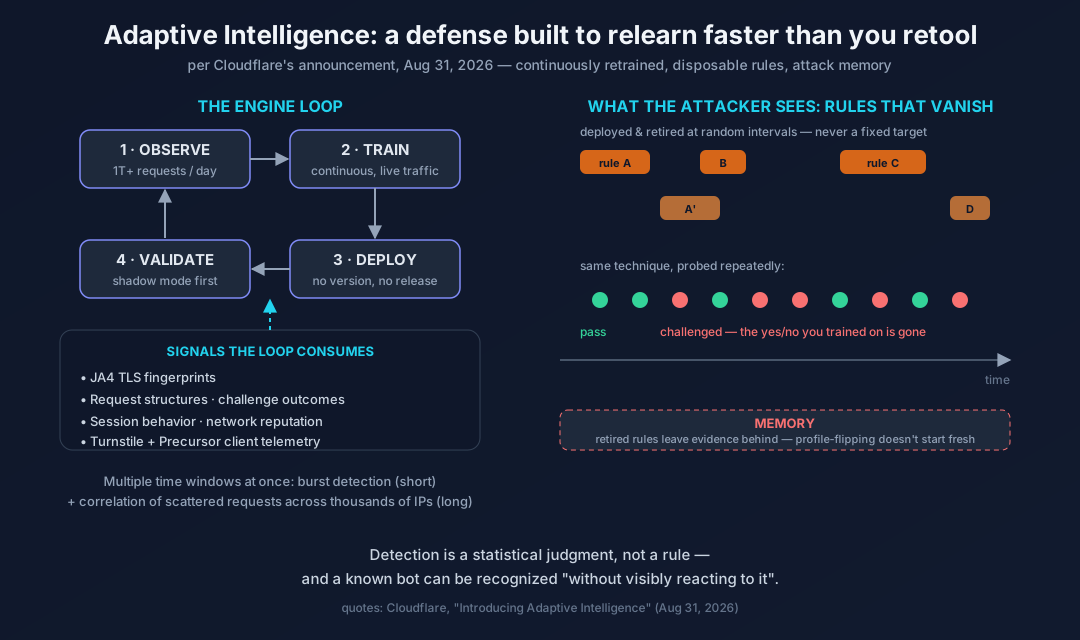
Adaptive Intelligence sits behind Cloudflare’s existing bot score — the 1–99 score that Bot Management customers already use in firewall rules — and layers three capabilities on top of the classic ML, heuristics, and fingerprinting stack:
| Component | What it does | Status at launch |
|---|---|---|
| Continuous retraining | The ML model behind the bot score retrains on live traffic continuously — “a technique that shows up this week is one the engine can recognize this week” — with no scheduled releases | Live (Aug 31, 2026) |
| Disposable rule generation | Narrow, attack-specific rules are created, deployed, and retired at random intervals, deliberately never becoming a fixed target | Announced, “soon to follow” |
| Learning from protected traffic | Customer-flagged misclassifications and measured misses become training signals across Cloudflare’s customer base | Announced, “soon to follow” |
The loop is observe → train → deploy → validate: new model weights roll out autonomously (“no version to choose and no upgrade to schedule”), and every candidate runs in shadow mode next to the current model — scoring live traffic without affecting visitors — before it becomes primary, gated on precision and recall.
Two design details deserve emphasis because they target the scraping workflow directly:
- Detection without reaction. The engine “can recognize a bot from a signal without visibly reacting to it, so the attacker keeps relying on a tell they do not realize we can see.” Your probe gets a PASS. Your technique is already burned. You have no way to tell the difference.
- Memory. Retired rules leave evidence behind: the system “keeps a memory of past attacks even after their detections stop firing, so an attacker cannot escape just by flipping between two profiles and betting the second one looks new.”
The signals it consumes
The announcement lists them explicitly: JA4 TLS fingerprints, request structures, challenge outcomes, session behavior, network reputation, and higher-level meta-signals, plus client-side telemetry from Turnstile (which Cloudflare says runs nearly 3 billion times per day) and Precursor. This is a network-to-client stack, and it is evaluated over multiple time windows simultaneously — a short window catches bursts, while a long window “reveals the behavior that repeats across thousands of addresses, clients, and sessions that have no reason to behave alike, and ties those scattered requests back to a single source.”
That last sentence is the quiet headline for anyone running distributed crawls: per-request innocence stopped being sufficient. The correlation unit is no longer the IP, or even the session — it is the pattern shared by a whole campaign.
Precursor: the client-side half
Precursor (July 13, 2026) extends detection from checkpoints to the entire session. A compact, obfuscated, dynamically-assembled script is injected into HTML responses at the edge — no third-party embed, no extra network connections from the page. It attaches listeners for pointer movement, keyboard activity, focus changes, and visibility, buffers the events in memory, and streams them to edge evaluators at regular intervals. Privacy constraints are part of the design: keyboard data is captured as timing and rhythm, never the keys themselves.
The evaluators cross-reference streams against each other — pointer activity must correlate with page-visibility duration, keyboard events must only fire when a text field is focused. And critically, the signature is session-scoped: it accumulates through the session and survives page refreshes and re-solved challenges. You cannot reset your way back to zero.
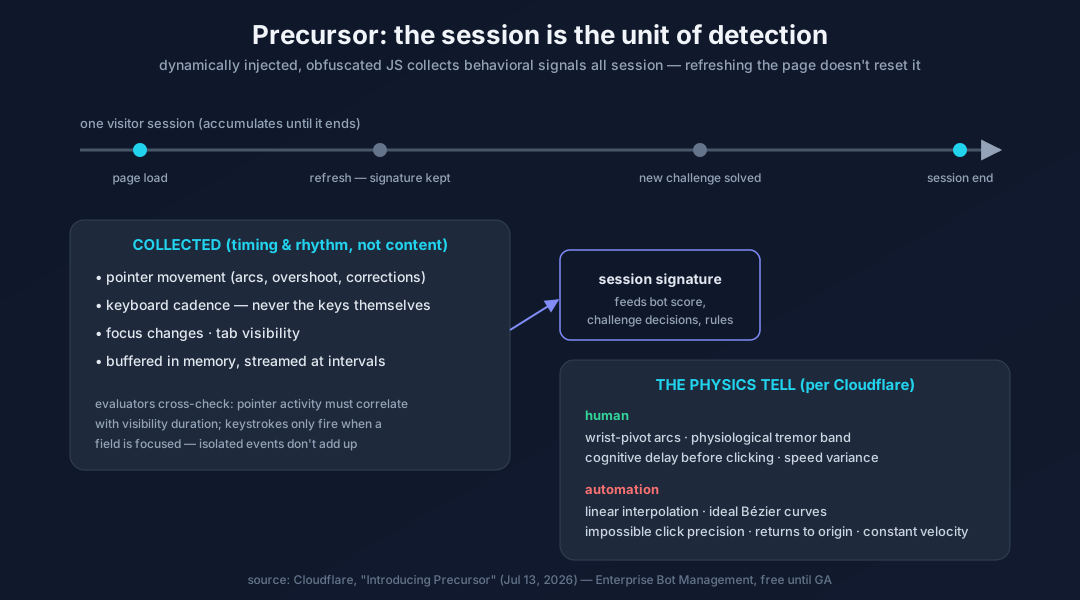
The human-vs-automation physics Cloudflare describes is worth internalizing, because it defines what “humanized” has to mean now: human mouse movement follows wrist-pivot arcs with overshoots and corrections, carries a measurable cognitive delay before clicks, and includes a physiological tremor band. Automation, meanwhile, “moves in linear interpolations or mathematically ideal Bézier curves”, clicks with impossible precision, returns to origin, and reacts at constant velocity. If your “humanization” library draws smooth Bézier curves with Gaussian jitter — the approach Cloudflare explicitly names — you are describing the adversary’s model, not evading it.
Why Your Bypass Test Stopped Being Evidence
Feedback starvation
The classic tuning loop is a feedback loop: probe the defense, observe the verdict, adjust, repeat. It works because a deterministic defense is an oracle — same input, same output, so every probe is a measurement that stays true.
Adaptive Intelligence is engineered to break exactly that property. Detection is “a statistical judgment rather than a fixed rule”, rules churn at random intervals, and — the sharpest edge — recognition can happen invisibly. A probe that passes tells you nothing about whether the technique behind it has been catalogued. The announcement says the goal is to “inject noise into the very signal an attacker relies on to train against us”.
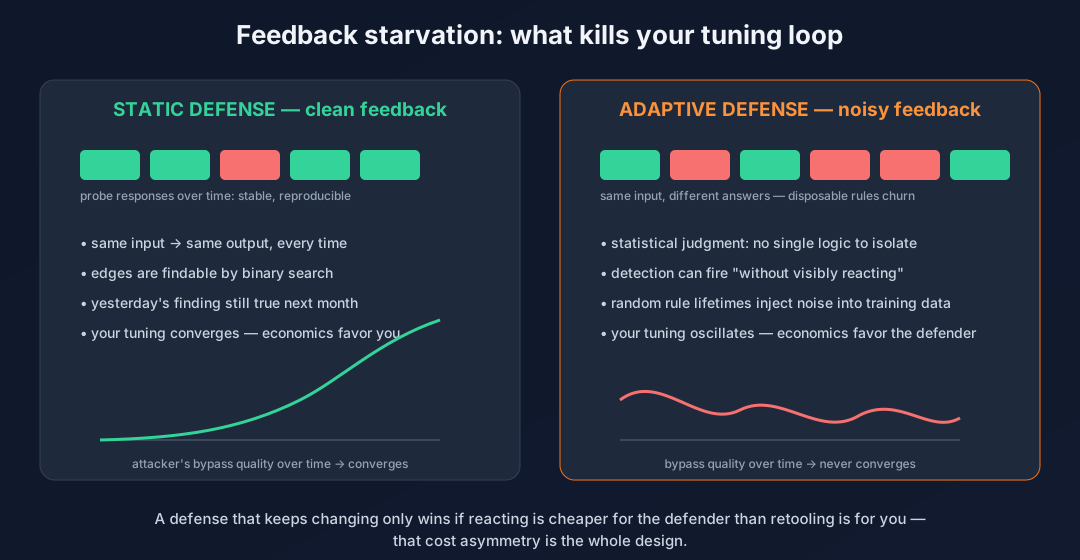
The consequence is not “harder to bypass”. It is epistemic: the thing your workflow produces — a verified observation about the defense — now has a shelf life set by the defender’s retraining cadence, and you don’t know the cadence. The announcement frames it as economics (“each new attempt costs more than the last”), but the mechanism is evidence decay.
Sample size does not fix drift — a Monte Carlo
Here is the point that most operations miss, and it is worth seeing numerically. We modeled an operator who probes a defense k times on day 0, ships a 14-day fleet if ≥ 80% of probes pass, and never re-measures — the default industry workflow. The defense has two states: UNLEARNED (probe passes 85% of the time, fleet burns 5%/day) and LEARNED (probe passes 10%, fleet burns 90%/day). A static defense never learns. An adaptive defense — encoding the published design: fast retraining, disposable rules, memory — flips to LEARNED after ~5 days on average and never forgets.
$ python simulate.py --trials 2000
[*] Operator ships a 14-day fleet if >= 80% of k day-0
    probes pass. Adaptive defense learns with mean 5 days, then
    remembers. Probe pass rates 85%/10%, daily fleet-burn 5%/90%
    (unlearned/learned). 2000 trials per cell.

    k | STATIC burn | ADAPT burn | ADAPT+canary | ADAPT E[days] | canary E[days]
    ------+-------------+------------+--------------+---------------+---------------
        5 |         51% |        97% |          16% |          4.4 |           3.3
       10 |         53% |        97% |          18% |          4.5 |           3.6
       30 |         51% |        97% |          19% |          4.4 |           3.5
      100 |         51% |        97% |          17% |          4.5 |           3.6
Three readings:
- Against the static defense, evidence accumulates. More probes, better ship decisions (the burn rate here is the baseline 5%/day risk, not bad decisions).
- Against the adaptive defense,
kis irrelevant. Going from 5 probes to 100 moves nothing. Your day-0 sample was perfectly accurate about day 0; the defense moved after you measured it. This is the shape of the new problem: it is temporal, not statistical. - The right column is the survivor. An operator who re-probes quietly every morning and pauses the fleet the first day the pass rate degrades cuts the burn rate from 97% to ~17% — and that residual is mostly the baseline risk, not the learning transition. You cannot stop the defense from learning your technique. You can stop betting stale evidence on it.
Caveat, stated plainly: this model encodes Cloudflare’s published design goals, not measured internals. We did not (and could not, without an Enterprise zone under our control) measure their actual retraining cadence. The lesson doesn’t depend on the specific numbers: any defense that actually relearns on a timescale shorter than your campaign imposes evidence expiry, and no sample size extends an expiry date.
The PoC: Measuring a Moving Defense
Two scripts: probe.py (live statistical harness) and simulate.py (the Monte Carlo above). Everything shown below is real output from our runs.
Know your client classes: the JA4 axis
Cloudflare names JA4 TLS fingerprints among the engine’s signals, so the first thing the harness does is make the network layer visible. python probe.py --ja4 prints the TLS fingerprint of each client cohort via the tls.peet.ws echo service:
$ python probe.py --ja4
[*] JA4 TLS fingerprint per cohort (via tls.peet.ws):
    chrome142       t13d1516h2_8daaf6152771_d8a2da3f94cd
    firefox147      t13d1717h2_5b57614c22b0_3cbfd9057e0d
    safari184       t13d2014h2_a09f3c656075_e42f34c56612
    plain-requests  t13d3113h1_e8f1e7e78f70_d339722ba4af
Four cohorts, four distinguishable network identities — including the plain-requests control, whose fingerprint (t13d3113h1_..., HTTP/1.1) announces “Python script” to any JA4-aware scorer before a single byte of page content loads. This is the layer curl_cffi impersonation manages; it is necessary hygiene, and — as the next run shows — nowhere near sufficient.
A live run, and what a flat result actually teaches
The harness defaults to a practice sandbox built for testing Cloudflare-challenge bypasses (scrapingcourse.com/cloudflare-challenge) — deliberately not a target anyone minds being probed. Four cohorts × 12 probes, interleaved over time (never batched — against a drifting defense, “all of A then all of B” confounds cohort with clock time), jittered 1.0–2.5 s apart:
$ python probe.py
[*] Target : https://www.scrapingcourse.com/cloudflare-challenge
[*] Plan   : 4 cohorts x 12 probes, jittered 1.0-2.5s
[*] This target is a practice sandbox; for your own targets, test only what you are authorized to test.

    [ 48/48] last: firefox147      CHALLENGE

[*] Results (pass rate with Wilson 95% CI):
    cohort           pass/  n       rate  95% CI             z vs ctrl
    chrome142          0 / 12     0.0%  [0.00, 0.24]      n/a  {'CHALLENGE': 12}
    firefox147         0 / 12     0.0%  [0.00, 0.24]      n/a  {'CHALLENGE': 12}
    safari184          0 / 12     0.0%  [0.00, 0.24]      n/a  {'CHALLENGE': 12}
    plain-requests     0 / 12     0.0%  [0.00, 0.24]      n/a  {'CHALLENGE': 12}
Two honest observations, and they are the point of the exercise:
- TLS class didn’t matter on this target. The sandbox serves a managed challenge to every non-JS client, browser-identical JA4 or not. The challenge layer sits in front of the network layer’s verdict — passing JA4 review just earns you the Turnstile. Layered defenses mean “my bypass works” is a per-layer claim, and this run shows a layer boundary cleanly.
- Look at the confidence interval, not the zero. With
n = 12and 0 passes, the Wilson 95% CI is[0.00, 0.24]— the data is consistent with a true pass rate as high as 24%. Twelve probes cannot even establish never, let alone reliably. Most “I tested it and got blocked” conclusions in this industry are built on samples this size, and the same arithmetic quietly applies to “it works”: 11/12 passing is a CI of[0.65, 0.99], not a guarantee.
Important scoping: this sandbox runs a managed challenge; we are not claiming it exercises Adaptive Intelligence itself (that’s an Enterprise Bot Management engine we don’t have a measurement window into). What the run demonstrates is the methodology — cohort discipline, interleaving, interval arithmetic — which is the part you own and control, on any target you’re authorized to test, against defenses that may or may not be moving under you.
The New Economics, and What Still Works
Cloudflare’s framing is cost transfer: the defender’s marginal cost of reacting (autonomous retraining, no scheduled releases) versus the attacker’s marginal cost of retooling. The announcement is blunt about what’s left on your side of the ledger — attackers “are primarily constrained by their time and their pool of proxies.” Read that as a design document: everything repeatable about your operation is the target; the two resources that survive are engineering time and IP inventory.
So what does a defensible operation look like under these assumptions? Our list, in order of leverage:
- Stop certifying, start monitoring. Replace day-0 bypass acceptance with a longitudinal canary: a low-rate probe cohort that runs alongside the fleet, measured with intervals (the PoC’s
probe.pyis exactly this), with automatic pause on degradation. The Monte Carlo showed this is the single biggest survivability lever — it converts “we got burned on Tuesday” into “we paused on Tuesday.” - Coherence before cleverness. Nothing in the announcement contradicts the fingerprint-coherence discipline from the Camoufox article — if anything, it weaponizes it: the engine’s automated signal-mining explicitly hunts for “a client that claims to be one browser while producing the network or JavaScript signals of another.” One coherent identity per session, all layers agreeing, network included.
- Budget for behavior, not just fingerprints. Precursor prices the session: wrist-pivot arcs, tremor, cognitive delays, speed variance — session-scoped, refresh-proof. Gaussian jitter on idealized curves is now a named, documented failure mode. Realistic behavior generation is a harder engineering problem than fingerprint spoofing, and that is precisely why it’s being priced in.
- Diversify techniques, not just IPs. Against disposable rules with memory, any single stable technique is a short-lived asset. Operations that rotate approaches (and can develop new ones quickly) degrade more gracefully than operations married to one tool.
- Treat your IP pool’s neighborhood as a signal. The long-window correlator ties together “requests that have no reason to behave alike.” Analysis, clearly labeled: a proxy pool whose addresses are dominated by other scrapers gives the correlator a dense, clean signature of shared behavior — you inherit your neighbors’ burn. An exit pool whose addresses carry overwhelmingly ordinary consumer traffic dilutes exactly that signal. This is the honest case for carrier-grade mobile exits, where thousands of real subscribers share each public IP and the IP’s reputation reflects them, not you — and it is why we run SimplyProxies, our own UK mobile proxy service on self-owned 4G/5G devices, for the targets where this matters. For everything else: datacenter exits for unprotected targets, residential for the middle ground — match the exit class to the target’s actual paranoia, and remember that no IP choice fixes an incoherent fingerprint or a detectable session.
The uncomfortable summary: the economics that favored tooling-up once and harvesting indefinitely are gone, by design. What remains is an operation that measures continuously, holds coherence across layers, behaves plausibly per-session, and can retool faster than its evidence expires.
Limits, Caveats, and What We Could Not Verify
An article that only relays a vendor’s design document is a press release. Here is the full caveat list:
- Adaptive Intelligence’s disposable-rule and memory components were “soon to follow” at announcement — only the continuously-retrained ML was live on Aug 31, 2026. Our analysis of those components is analysis of stated design, not observed behavior.
- We could not measure the engine itself. It ships inside Enterprise Bot Management; our live run exercised a managed-challenge sandbox, which demonstrates methodology and layering, not Adaptive Intelligence internals. Nobody outside Cloudflare has published an independent measurement of its retraining cadence or score drift that we could find — treat any claim you read to the contrary, including “it’s just marketing”, as speculation.
- The Monte Carlo parameters are illustrative. The 5-day learning mean, the 85%/10% pass rates — chosen for clarity, not measured. The structural lesson (evidence expiry defeats sample size; longitudinal measurement survives it) is robust to the parameters, but the specific percentages are not predictions.
- Non-determinism has a false-positive cost too. Cloudflare’s own post acknowledges the bar: real visitors wrongly turned away “is the failure that actually costs,” and every new detection runs in shadow mode first. A statistical defense that keeps moving also keeps misjudging occasionally — the published validation loop is the mitigation. Whether the trade-off nets out is a question only live traffic answers.
- Precursor is JavaScript-collected. A sufficiently controlled browser environment could, in principle, fabricate the event streams — but it must fabricate cross-consistent physics over an entire session, refresh-proof, and Cloudflare explicitly designed for cross-referencing streams against each other. Feasible for a determined adversary is not the same as economical at fleet scale; the design targets the economics.
- Verified vs folklore, in one line: everything in quotation marks above is from Cloudflare’s two posts (primary sources for their own stack); everything about how scrapers should respond is our analysis, labeled as such.
Responsible Scraping
The harness in this article measures defenses; it doesn’t break them. Point it at infrastructure you own, sandboxes built for practice, or targets where you have authorization and a legitimate data-collection right. Keep volumes polite — statistical discipline means you need less probing, not more: a cohort with honest intervals beats an afternoon of ad-hoc curling. Respect robots and ToS where your jurisdiction requires it, don’t cross authentication boundaries, and prefer licensed APIs and datasets when they exist. Nothing here changes the legal landscape; it changes how quickly your technical assumptions expire.
Sources
- Cloudflare — Introducing Adaptive Intelligence: undermining the economics of every bot attack (Aug 31, 2026): https://blog.cloudflare.com/introducing-adaptive-intelligence/
- Cloudflare — Introducing Precursor: detecting agentic behavior with continuous client-side signals (Jul 13, 2026): https://blog.cloudflare.com/introducing-precursor/
- Cloudflare docs — Bot Management: https://developers.cloudflare.com/bots/
- Cloudflare docs — Precursor: https://developers.cloudflare.com/cloudflare-challenges/precursor
- Cloudflare docs — Turnstile: https://developers.cloudflare.com/turnstile/
- FoxIO — JA4+ method for network fingerprinting: https://github.com/FoxIO-LLC/ja4
- curl_cffi — Python HTTP impersonation library: https://github.com/yifeikong/curl_cffi
- tls.peet.ws — TLS fingerprint echo service: https://tls.peet.ws/
- ScrapingCourse — Cloudflare challenge practice sandbox: https://www.scrapingcourse.com/cloudflare-challenge
- Wilson, E.B. (1927) — probable inference, the law of succession, and statistical inference (Wilson score interval): https://doi.org/10.1080/01621459.1927.10502953
- Hunt-Benito — The Fingerprint That Hangs Together: Coherent Identity Spoofing with Camoufox: https://www.hunt-benito.com/blog/the-fingerprint-that-hangs-together-coherent-identity-spoofing-with-camoufox/
- Hunt-Benito — Type What You Hear: A History and Evolution of CAPTCHA Bypass: https://www.hunt-benito.com/blog/type-what-you-hear-a-history-and-evolution-of-captcha-bypass/